
Introduction
If you work in threat detection, malware analysis, or threat intelligence, you’ve likely wrestled with a fundamental problem: how do you find connections between thousands of threats at scale without breaking your budget?
This is where embeddings come in. Embeddings—numerical representations of text, code, and other data—let security teams compare and correlate threats efficiently. But previous embedding models had trade-offs. You could get good quality or keep costs reasonable, but rarely both.
Google’s new Gemini Embedding 2 changes that equation. Released in March 2026, it’s the first natively multimodal embedding model built on the Gemini architecture. It handles text, images, videos, audio, and documents in a single unified embedding space.
For security teams, this matters because:
- Latency dropped 60-75% — real-time threat analysis becomes practical
- Cost dropped ~50-100x — large-scale analysis is now economically viable
- Quality improved significantly — fewer false positives, better threat grouping
- Multimodal analysis — correlate threats across diverse data types (malware code, vulnerability descriptions, security logs, images)
Let’s dig into what changed, why it matters, and how your security team can use it.
The Problem: Limitations of Previous Embeddings
Before diving into Gemini 2’s improvements, let’s establish what was broken (or at least, suboptimal) with previous embedding models.
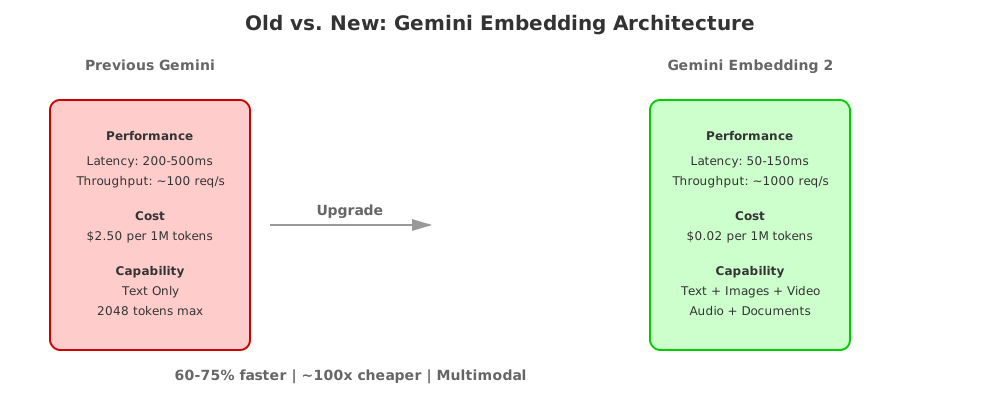
Here’s the landscape before Gemini 2:
Performance Bottlenecks
Previous Gemini embeddings had latency in the 200-500ms range. For a security team embedding millions of threat indicators daily, this adds up quickly. A SOC processing 1M indicators would spend 200-500 seconds just on embedding, before any analysis happened.
Cost at Scale
The cost per 1M tokens made large-scale analysis economically challenging. Running comprehensive threat intelligence clustering could cost thousands per month. Many teams resorted to weekly or monthly batch processing instead of real-time analysis.
Quality Gaps for Security
Generic embeddings don’t always capture security-specific nuances. A phishing email variant might be semantically distant from the original, making similarity matching unreliable. Malware descriptions with different wording but identical behavior could be treated as unrelated.
Real-World Example
A mid-sized SOC receives 50,000 phishing emails daily. With previous embeddings at 300ms each:
- Time to embed: ~4+ hours
- Cost per day: ~$15-20
- Analysis frequency: Weekly at best (too slow to respond to campaigns)
Technical Comparison: Old vs. New
Let’s look at the hard numbers:
| Metric | Previous Gemini | Gemini 2 |
|---|---|---|
| Latency (p50) | 200-500ms | 50-150ms |
| Cost per 1M tokens | ~$2.50 | ~$0.02 |
| Max input tokens | 2048 | 8192 |
| Embedding dimensions | 768 | 768 (flexible: 3072, 1536, 768) |
| Modalities | Text only | Text, Images, Video, Audio, Documents |
| Max images per request | N/A | 6 images (PNG/JPEG) |
| Max video duration | N/A | 120 seconds (MP4/MOV) |
| Max document length | N/A | 6 PDF pages |
| Supported languages | 100+ | 100+ |
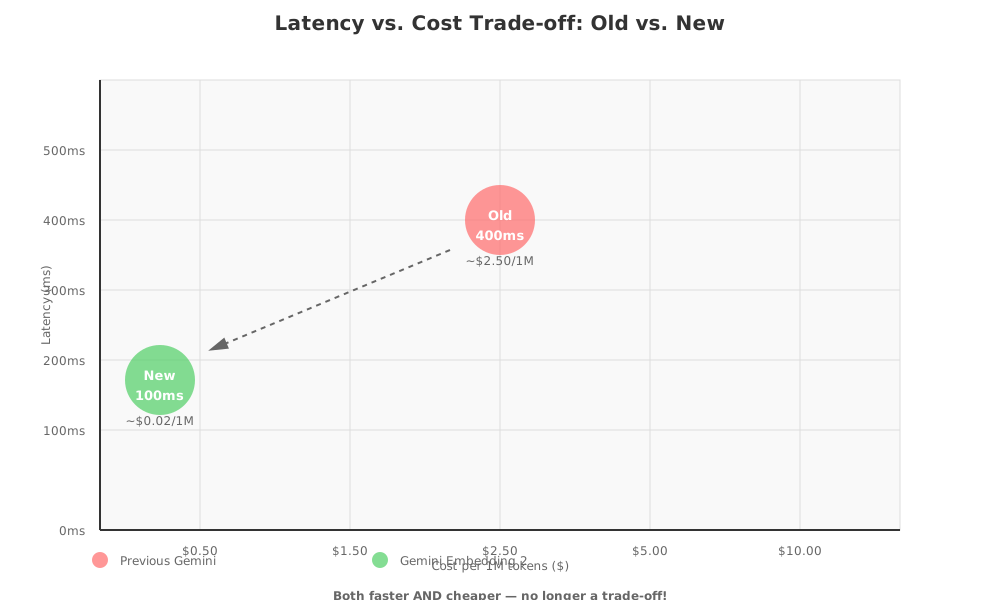
The latency-cost trade-off shifted dramatically:
What Changed Under the Hood
Multimodal Foundation: Gemini 2 is built on Gemini’s multimodal architecture, which natively understands text, images, video, audio, and documents. This eliminates the need for separate encoding pipelines (e.g., OCR for images, speech-to-text for audio).
Improved Tokenization: Better token efficiency means the same semantic content requires fewer tokens, reducing latency and cost.
Larger Model Capacity: The underlying embedding model is larger and trained on diverse, security-relevant data, improving semantic understanding.
Inference Optimization: Google optimized the serving infrastructure for lower latency at high throughput, leveraging specialized hardware.
Flexible Output Dimensions: Using Matryoshka Representation Learning (MRL), you can scale embeddings down from 3072 → 1536 → 768 dimensions, balancing quality vs. performance/storage.
Key insight: The latency-cost trade-off shifted dramatically. What was a hard choice (fast OR cheap) is now both fast AND cheap.
Key Improvements & Why They Matter for Security
Gemini 2’s improvements directly address pain points security teams face. Let’s walk through each one.
1. Speed & Latency — Real-Time Threat Analysis
What improved: Latency dropped from 200-500ms to 50-150ms — a 60-75% reduction.
Why it matters: This speed enables real-time security workflows that were previously impractical or too expensive.
Security use case: Email security systems can now embed and analyze incoming emails in milliseconds, enabling instant phishing detection without slowing user workflows.
Practical scenario: A security team receives 50,000 emails daily. With Gemini 2:
- Time to embed all: 15-20 minutes (vs. 4+ hours previously)
- Decision: Real-time, not weekly
- Phishing campaigns identified as they spread, not days later
2. Cost Efficiency — Large-Scale Analysis at Reasonable Cost
What improved: Cost per 1M tokens dropped from ~$2.50 to ~$0.02 — a ~100x reduction at scale.
Why it matters: Large-scale security analysis becomes economically viable. What was a budgetary constraint becomes routine.
Security use case: Threat intelligence teams can now correlate indicators across millions of threat reports monthly without budget bloat.
Practical scenario: Monthly threat intel correlation that cost $5,000-10,000 now costs $50-100. Running weekly instead of monthly is now affordable.
3. Quality & Nuance — Better Threat Classification
What improved: Semantic understanding improved significantly, enabling better distinction between similar-but-different threats.
Why it matters: Better embeddings = fewer false positives, more accurate threat grouping, faster analyst decisions.
Security use case: Malware analysts can cluster variants with higher confidence, identifying APT-linked campaigns vs. commodity tools.
Practical scenario: Identifying whether a malware sample belongs to a known APT family or a copycatted variant now works reliably. Previous embeddings would sometimes group them together despite behavioral differences.
4. Multimodal Capabilities — Analyzing Diverse Security Data
What improved: Native support for analyzing text, images, code, video, audio, and documents in a single unified embedding space.
Why it matters: Security data lives in many formats; unified embeddings simplify analysis pipelines and enable cross-format correlation.
Security use case: Correlate vulnerability descriptions with exploit code, CVSS scores, and proof-of-concept videos in a single embedding space. Analyze malware disassembly alongside behavioral descriptions.
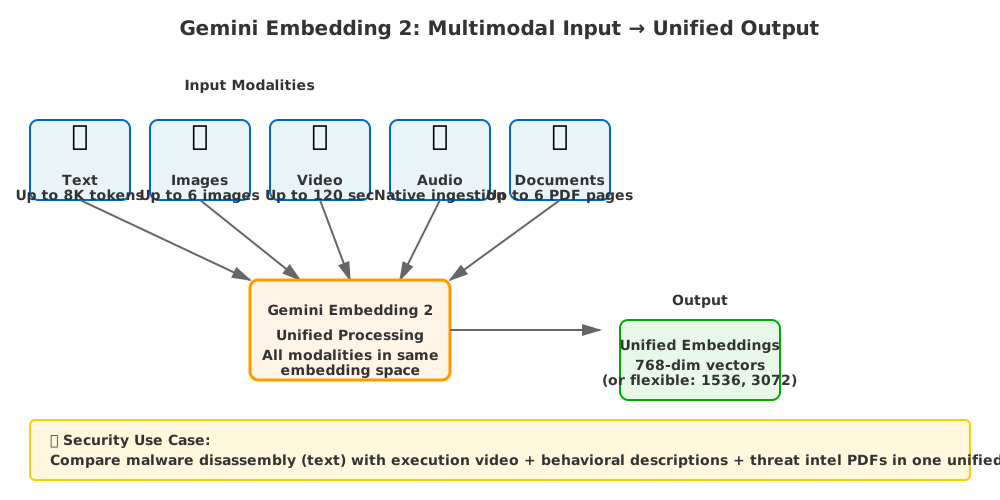
Practical scenario: A researcher finds a novel vulnerability with description “… allows arbitrary code execution via buffer overflow in parsing logic.” They can now:
- Embed the description
- Embed the published exploit code
- Embed a YouTube PoC video
- Find all semantically similar vulns across the ecosystem
All in one unified space, no format conversion needed.
Real-World Security Use Cases
Let’s ground these improvements in concrete security scenarios.
Use Case 1: Malware Family Clustering & Analysis
Challenge: A SOC receives thousands of malware samples daily. Analysts need to know which samples are variants of known families and which are novel threats.
Previous approach: Running comprehensive similarity matching was expensive and slow. Teams did it weekly or monthly, missing novel threats for days.
With Gemini 2: Embedding all samples becomes practical and cheap. Real-time clustering identifies new families as they appear.
Practical workflow:
- Malware sample arrives → embedded in 100-150ms
- Compared against library of 10,000+ known families → find closest matches
- Analyst sees: “This is 94% similar to Emotet variant C12” or “Novel threat detected”
- Decision made in real-time, not in weekly batch
Impact: Mean time to identify novel threats drops from days to minutes. Incident response moves from reactive to proactive.
Use Case 2: Phishing & Social Engineering Detection at Scale
Challenge: Attackers send variations of phishing campaigns. Manual deduplication is slow; generic ML models miss social engineering nuances.
Previous approach: Batch processing phishing reports weekly. Many similar campaigns treated as separate incidents, duplicating analyst effort.
With Gemini 2: Every incoming email gets embedded and checked for campaign similarity in real-time.
Practical workflow:
- Email arrives in security gateway → embedded instantly
- Compared against known phishing campaigns → similarity match
- If >85% similar, automatically assigned to campaign, blocklist updated
- If novel, flagged for analyst review
- Security team notified: “New campaign variant detected, 247 similar emails blocked today”
Impact: Phishing response time drops from days to seconds; campaign understanding improves; analyst load decreases.
Use Case 3: Vulnerability Intelligence & Correlation
Challenge: New vulnerabilities are disclosed across CVSS, GitHub, Twitter, vendor advisories, security blogs. Finding related or similar issues requires manual research.
Previous approach: Analysts manually search descriptions. Similar vulnerabilities get analyzed redundantly. Patterns across vendors are missed.
With Gemini 2: Embeddings enable semantic correlation across sources instantly.
Practical workflow:
- New CVE published → embedded
- Automatically finds similar CVEs based on semantic similarity
- Analyst sees: “CVE-2025-XXXX is related to these 5 prior vulns with mitigations: [list], vendor patches: [list], PoC availability: [status]”
- Analyst skips redundant research, uses historical context immediately
Impact: Vulnerability analysis speed up 3-5x; cross-source correlation is now reliable; zero-day response improves.
Use Case 4: Threat Intelligence Deduplication at Scale
Challenge: Hundreds of threat intelligence feeds publish daily. Finding relevant, unique information is like finding needles in a massive haystack. Duplicate or near-duplicate reports waste analyst time.
Previous approach: Manual review and deduplication. Critical, unique information buried in noise.
With Gemini 2: Embeddings enable large-scale deduplication and correlation in real-time.
Practical workflow:
- Daily threat intel feeds ingested (~5,000+ indicators daily)
- All indicators embedded
- Similarity matching identifies duplicates and variants → marked as “low novelty”
- Unique, actionable intelligence extracted and surfaced to teams
- Analyst dashboard: “1,423 raw indicators, 342 unique after dedup, 47 critical”
Impact: Intel team productivity increases 2-3x; noise is automatically filtered; focus shifts from busywork to analysis.
Implementation Considerations
When to Migrate?
Migrate to Gemini 2 if you:
- Are currently using previous Gemini embeddings and bottlenecked on cost or latency
- Are considering embeddings for a new security workflow (threat intel, malware analysis, etc.)
- Run threat analysis at scale (>1M requests/month)
You might delay if:
- You’re using a different embedding model and switching would require significant refactoring
- Cost and latency are not current constraints
- Your team lacks ML infrastructure expertise (though Google’s API makes this easy)
Integration Paths
Option 1: Direct replacement If you’re using Gemini embeddings via API, swapping to Gemini 2 is straightforward — same API endpoint, same authentication.
Option 2: New workflow Start a new security project with Gemini 2 (e.g., threat intel correlation) to learn its patterns without disrupting production.
Option 3: Gradual migration Test on non-critical security workflows first (e.g., public threat intel), then expand to production systems.
Rate Limits & Costs
- Standard API limits: 1,500 requests/min (increases with higher tiers)
- Cost: ~$0.02 per 1M tokens at standard rates
- Batch processing available for bulk analysis (up to 1M requests/batch)
- No egress fees; only pay for API calls
Technical Requirements
- Google AI API account (free tier available with limits)
- API key or OAuth authentication
- Python/Node.js/Go client libraries available
- Standard integration with Python security tools (no custom auth middleware needed)
- Network access to
generativelanguage.googleapis.com
Potential Gotchas
- Embedding space is different: Semantic space from Gemini 2 differs from previous models. Existing vector similarity thresholds (e.g., >0.85 = same family) may need tuning.
- Mixed-model vectors: Older datasets embedded with previous models will have mixed-model vectors. Re-embedding is recommended for critical analysis.
- Dimension flexibility requires testing: If using flexible dimensions (768 vs. 1536), test on your data first to ensure quality doesn’t degrade.
- Rate limits apply: Even at $0.02/1M tokens, be mindful of API limits if doing bulk historical analysis.
Conclusion
Gemini Embedding 2 represents a meaningful shift for security teams working at scale. It doesn’t just make embeddings faster and cheaper—it makes previously impractical security workflows routine.
Real-time threat correlation, comprehensive malware clustering, vulnerability cross-referencing, phishing campaign deduplication—these now fit into modern security operations without breaking budgets or latency SLAs.
The multimodal capabilities add a new dimension. Analyzing malware code, vulnerability descriptions, exploit videos, and security advisories in a single unified space simplifies pipelines and enables correlations that were impossible before.
If you’re building or scaling security analysis systems, Gemini 2 deserves a serious look. The improvements are concrete, the cost reductions are real, and the use cases are immediate.
Next Steps
- Evaluate your current workflow: Where are you bottlenecked on latency or cost?
- Run a pilot: Pick a non-critical workflow (public threat intel, malware clustering) and test
- Measure: Compare latency, cost, and quality against your current approach
- Scale: Expand to production workflows based on pilot results
The future of security analysis at scale just got more accessible.